

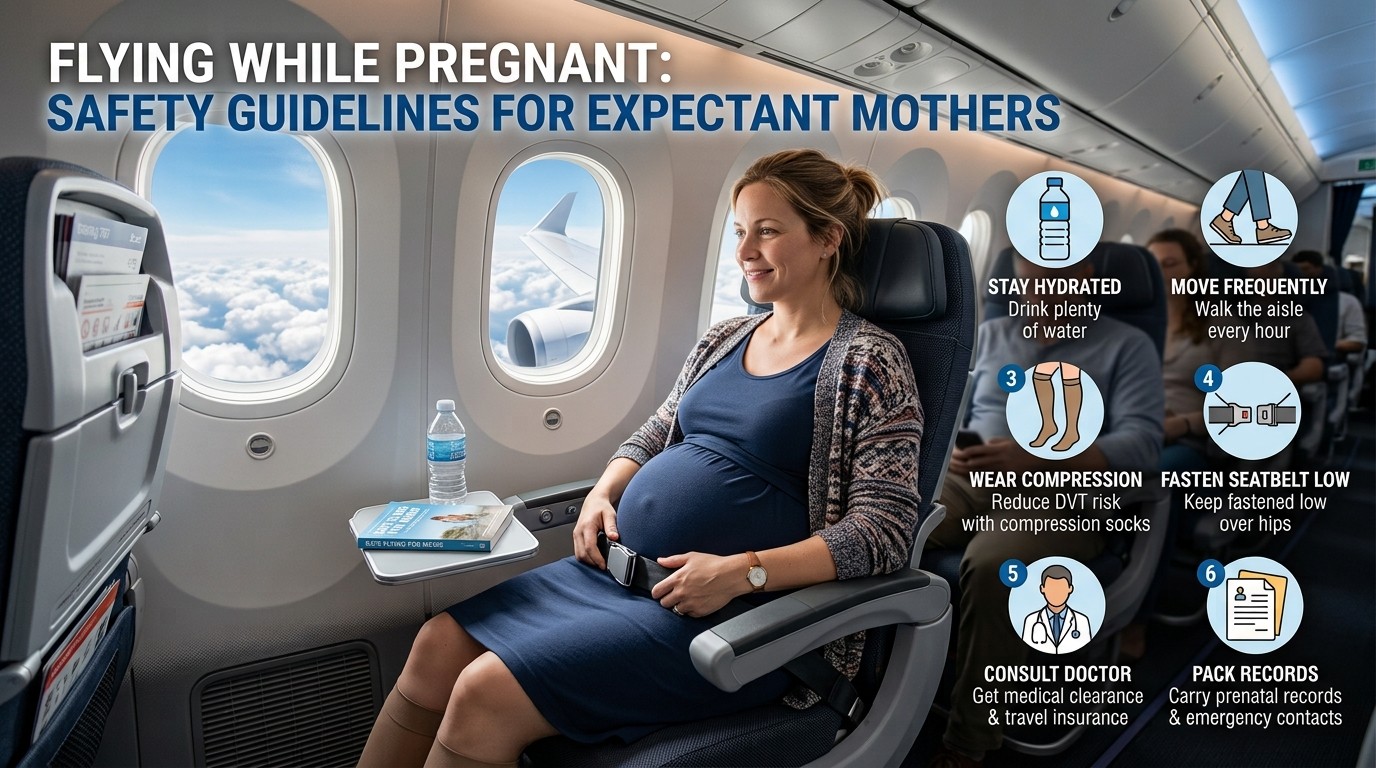
Flying While Pregnant is usually safe in uncomplicated pregnancies when timing, hydration, movement, and doctor-approved precautions are handled well. Flying While Pregnant becomes much easier when you plan ahead and know when to postpone.
Flying While Pregnant is one of the most common questions expectant mothers ask because air travel sits at the intersection of comfort, confidence, and caution. In most normal pregnancies, travel is possible with preparation, but the safest choice depends on your stage of pregnancy, your health, and your destination. Flying While Pregnant should not be treated as a one-size-fits-all decision because medical guidance emphasizes individual risk, especially when a pregnancy needs close monitoring or has complications.
Flying While Pregnant is generally considered acceptable in uncomplicated pregnancies, and that matters because many women worry that the pressure change, cabin air, or movement itself might harm the baby. Official guidance from the CDC and NHS says routine air travel is usually fine in a normal pregnancy, while the main caution is around late pregnancy, complications, and specific infection risks at the destination. Flying While Pregnant becomes a safer choice when you combine that reassurance with real planning.
When flying is usually safest
Flying While Pregnant is often easiest in mid-pregnancy, when nausea is often improving and the body is not yet carrying the full discomfort of the final trimester. NHS guidance notes that many women find the middle months more comfortable for travel, and that air travel is not harmful to mother or baby when the pregnancy is uncomplicated. Flying While Pregnant during this window often feels more manageable because the body is usually more stable and the chance of labor is still lower than at the end of pregnancy.
Flying While Pregnant in the first trimester is not automatically unsafe, but it can feel harder because nausea, fatigue, and emotional sensitivity are common during early pregnancy. The CDC notes that the risk of obstetric complications is higher in the first and third trimesters, which is why a woman with symptoms or risk factors should speak with her clinician before booking. Flying While Pregnant in this stage is less about the plane itself and more about whether you feel well enough to travel comfortably.
Flying While Pregnant in the third trimester needs closer attention because labor can begin unpredictably, especially later in the term. NHS and RCOG guidance both note that many women prefer not to fly after 37 weeks with a singleton pregnancy, and after 32 weeks in an uncomplicated twin pregnancy. Flying While Pregnant this late may also be restricted by airline policy, so medical timing and carrier rules should both be checked before you commit.
Who should be extra careful
Flying While Pregnant should be discussed with a doctor if the pregnancy involves bleeding, preterm labor risk, placenta issues, high blood pressure, severe anemia, recent surgery, clot history, or any need for frequent antenatal monitoring. The CDC says travel is rarely contraindicated in a normal pregnancy, but pregnancies that require close supervision may need postponement. It is safest when the trip does not compete with your medical care or make emergency access difficult.
It’s also deserves caution if the destination has limited medical infrastructure or if your return trip would be difficult to change in an emergency. NHS guidance recommends knowing what healthcare is available at the destination and carrying maternity records so doctors abroad can understand your history if needed. And it’s just about the flight hours; it is about everything that might happen before takeoff, during travel, and after landing.
Airline rules and documentation
Flying While Pregnant often becomes a paperwork question as well as a health question. Airlines commonly have their own restrictions, and NHS guidance notes that after around 28 weeks, some carriers may ask for a letter confirming the due date and that the pregnancy is uncomplicated. RCOG also notes that airline policies vary, so the specific carrier’s rules matter. Flying While Pregnant is smoother when the clinician’s advice, the airline policy, and the travel date all line up.
Flying While Pregnant is easier when you do not assume every airline will treat pregnancy the same way. Some allow travel later than others, and some require forms that are valid only for a limited time before departure. Flying While Pregnant should therefore be confirmed with the airline directly, especially if you are near the end of the second trimester or beyond. A small amount of admin now can prevent a stressful airport delay later.
Blood clot prevention matters
Flying While Pregnant raises attention around deep vein thrombosis, especially on long-distance flights. NHS guidance says long-distance travel of more than four hours carries a small risk of blood clots, and recommends drinking water and moving regularly, roughly every 30 minutes when possible. RCOG and other health sources also emphasize that pregnancy itself is a clot-risk state, so stillness on a long flight is something to plan against. And is safest when circulation stays active.
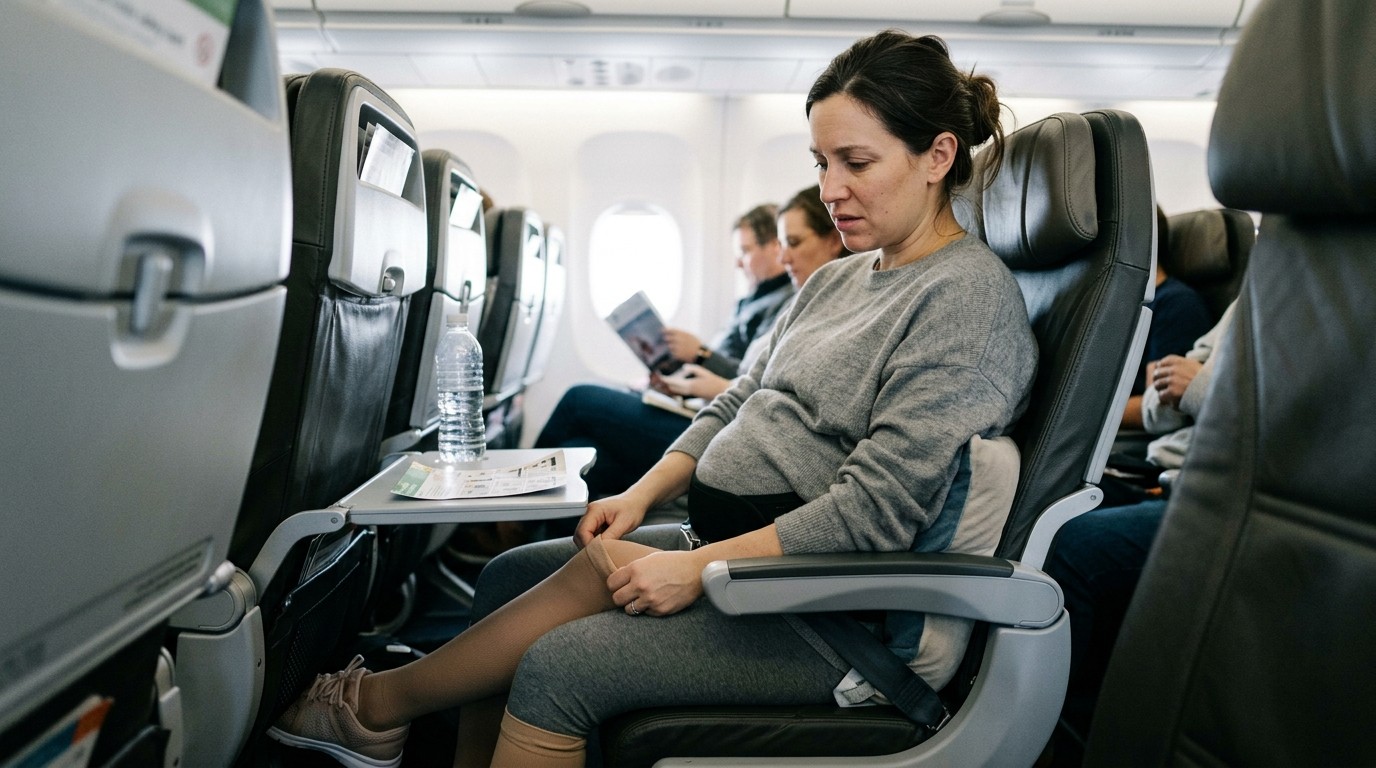
It’s becomes more comfortable when you use simple movement habits. Flexing your ankles, walking the aisle when appropriate, and avoiding long stretches of immobility all help keep circulation moving. Healthdirect also notes that compression stockings can help reduce leg swelling and support circulation during long journeys, while NHS says they can help reduce the chance of blood clots. And it is not about staying perfectly still; it is about staying safely mobile.
Flying While Pregnant on a long-haul route may also call for a practical seat choice. An aisle seat can make it easier to get up often, stretch, and use the restroom without awkwardly climbing over other passengers. This is not a formal medical rule, but it is a sensible comfort strategy that fits the circulation advice from NHS and healthdirect. It should feel less like endurance and more like a well-managed journey.
Seat belts and posture
Flying While Pregnant does not mean skipping safety restraints. In seat-belt guidance for pregnancy, RCOG and ACOG both advise that the lap belt should sit low, under the abdomen and across the hips or pelvic bones, not across the bump. Although ACOG’s published guidance is for car travel, the same body-position principle is useful on flights when a seat belt is required. It is safer when restraint is worn correctly rather than loosely or incorrectly.
It’s also benefits from good posture. Sitting with support under the lower back, keeping shoulders relaxed, and avoiding cramped positions can reduce fatigue during longer flights. These are not dramatic interventions, but they matter because pregnancy changes the center of gravity and can make sitting for a long time uncomfortable. It is usually less tiring when the body is supported instead of compressed.
Hydration and cabin comfort
Flying While Pregnant should always include a hydration plan because dehydration can worsen fatigue, headaches, and discomfort. NHS guidance specifically recommends drinking plenty of water during flights. Cabin air is dry, movement is limited, and pregnancy already increases the body’s needs, so water is one of the simplest protective habits available. Flying While Pregnant becomes more manageable when you treat water as part of the travel equipment rather than an afterthought.
It is also easier when you avoid overdoing caffeine, salty snacks, and heavy meals right before boarding. That is a comfort suggestion rather than a strict rule, but it aligns with the general goal of preventing nausea, swelling, and digestive discomfort. A lighter meal, enough water, and an unhurried airport routine often create a calmer experience. Flying While Pregnant is usually best when the body is kept steady rather than overloaded.
Medical records, insurance, and destination planning
Flying While Pregnant should always include travel insurance and accessible maternity records. NHS guidance says insurance should cover pregnancy-related medical care, premature birth, labor, and possible return-date changes if labor begins while away. WHO also advises travelers to carry enough prescribed medication and supplies for possible delays and changes of plan. Flying While Pregnant is much safer when the logistics around emergencies are already handled.
Flying While Pregnant is not only about your flight day; it is also about whether the destination can support you if something unexpected happens. NHS recommends checking what healthcare facilities exist where you are going and bringing your maternity notes. Flying While Pregnant becomes more responsible when you assume that a complication could happen even if the trip is planned carefully. That is not fear; it is preparation.
Infection risk and destination safety
Flying While Pregnant should be evaluated differently when the destination has mosquito-borne or travel-related infection risk. CDC guidance says pregnant travelers should avoid destinations with Zika or malaria risk when possible, because these infections can seriously affect pregnancy outcomes. NHS similarly advises pregnant women to consider avoiding travel to Zika-risk countries. Flying While Pregnant is safer when the destination is low-risk and the exposure profile is well understood.
Flying While Pregnant in a mosquito-prone area means prevention matters even more. CDC recommends preventing mosquito bites and discussing risks with a healthcare provider before travel, especially when Zika exposure is possible. In some regions, malaria prevention and other infection precautions may also be important. Flying While Pregnant should not be booked casually to a region where the pregnancy could be exposed to avoidable infectious risk.
Travel vaccinations and pregnancy

Flying While Pregnant may require a travel clinic conversation if the destination needs Travel Vaccinations or if you are crossing regions with different infectious disease risks. Healthdirect notes that people who are pregnant have a higher risk of infection while traveling and may need vaccinations before travel, depending on the destination. CDC’s pre-travel consultation guidance says that the best opportunity to reduce risk is before the trip, when itinerary, duration, and activities can all be reviewed. Flying While Pregnant is safer when vaccine decisions are handled early.
Flying While Pregnant does not mean every vaccine is appropriate, because pregnancy changes the risk-benefit calculation. Some vaccines may be recommended, some deferred, and some avoided depending on the situation and the country you are visiting. That is why a clinician familiar with pregnancy and travel medicine should make the final call. Flying While Pregnant becomes less stressful when the vaccine question is settled before the airport question even begins.
Motion sickness and nausea control
Flying While Pregnant can be uncomfortable for anyone dealing with nausea, and early pregnancy often makes this more noticeable. Healthdirect advises that if you need travel-sickness medicine while pregnant, you should ask a doctor or pharmacist first because medication choice matters in pregnancy. Flying While Pregnant is easier when you do not self-prescribe randomly, especially if you already take other medicines.
Flying While Pregnant becomes more tolerable when you combine medical caution with practical comfort steps. Gentle snacks, sitting near the wing, slow breathing, a cooler seat area if possible, and rest can all help reduce nausea or motion discomfort. These are supportive habits rather than medical treatment, but they often make the difference between a difficult trip and a manageable one. Flying While Pregnant is best handled with calm, not panic.
Flight anxiety and emotional readiness
Flying While Pregnant may also bring emotional stress, especially if the mother is already feeling protective or anxious. Calm routines help: arrive early, keep documents together, use breathing techniques, avoid rushing, and tell the crew if you need extra assistance. For travelers who also search for Flight Anxiety Tips, the key is to reduce uncertainty before boarding so the nervous system has fewer surprises to process. Flying While Pregnant often feels much easier when the day is deliberately simple.
Flying While Pregnant can become mentally easier if you treat the trip as a series of small tasks rather than one giant event. Security, boarding, sitting, hydrating, moving, and landing each become manageable when broken down. This approach helps many anxious travelers feel more in control. Flying While Pregnant is not just a physical experience; it is an emotional one, and calm structure is one of the best tools available.
Planning style and travel purpose
It’s should also be judged by why you are traveling. A necessary family event, medical visit, or relocation has a different value than a discretionary leisure trip. The CDC pre-travel guidance emphasizes looking at the purpose of the trip, its length, and the planned activities. It is therefore best assessed through usefulness, not just desire. If the trip is optional and risk is rising, postponing may be the wiser choice.
Flying While Pregnant can fit into many life phases, but the same trip may feel very different depending on your energy level and trimester. Some people compare this decision-making to Workation vs Vacation because both are about matching the trip to the body’s actual capacity. In pregnancy, the gap between wanting to go and being well enough to go matters more than usual. It’s should serve health, not compete with it.
Thinking about travel style and sustainability
Flying While Pregnant also connects to broader travel values. Travelers who reflect on Eco Travel vs Traditional Travel often become more aware of whether a trip is necessary, how much movement is reasonable, and what health or environmental cost is involved. That kind of reflection is useful in pregnancy too, because it encourages more deliberate decisions. Flying While Pregnant is not wrong, but it should be chosen for a clear reason rather than out of habit.
It’s sometimes appeals to people who are otherwise comfortable with frequent travel, but pregnancy changes the tolerance for uncertainty. A route that would normally feel routine may now need more buffers, more rest, and more backup planning. That is not a sign of weakness. It is a sign that the trip should match the body’s current needs. It’s works best when the plan respects that reality.
What to pack for the flight
Flying While Pregnant becomes easier when you carry the essentials close at hand. Keep water, snacks, any approved medication, your travel documents, maternity notes, a phone charger, and anything that helps you stay comfortable during long sitting periods. If you know the route may be hot or the aircraft cold, add a light layer and plan for temperature changes. Flying While Pregnant is smoother when comfort is not left to chance.
It’s also benefits from a mindset of “prepared, not packed for every possible scenario.” Too much luggage creates stress, and stress can make travel feel harder than it needs to be. Keep the load light enough to move easily while still being thoughtful about medical and comfort needs. Flying While Pregnant should feel organized, not burdensome.
Long-haul flights and rest strategy
Flying While Pregnant on a long-haul route needs a deliberate rest strategy because long sitting time amplifies fatigue and swelling. This is where movement breaks, hydration, compression stockings, and aisle access become especially useful. NHS notes that moving regularly and drinking water are important on long-distance travel, and healthdirect reinforces the value of preventing DVT during transit. Flying While Pregnant on a long flight is usually more comfortable when it is treated as a small endurance event with recovery built in.
It’s becomes safer when sleep is protected before and after travel. If you know the journey will be long, avoid arriving already exhausted if possible. A tired body tolerates discomfort less well and can make minor symptoms feel more alarming than they are. Flying While Pregnant is not just about what happens in the cabin; it is about the whole travel day.
When to stop and call your doctor
Flying While Pregnant should stop being a casual travel decision if you have bleeding, contractions, fluid leakage, reduced fetal movement, severe pain, shortness of breath, or any new symptom that worries you. Even if the cause turns out to be minor, symptoms like these need medical attention. Flying While Pregnant is safest when you treat warning signs seriously and do not try to “push through” them.
It’s also requires medical review if you have already been advised not to travel, if you are on medication that needs monitoring, or if the airline requests a fitness-to-fly letter. The safest answer is always the one that comes from your own clinician, because only they know your full pregnancy history. Flying While Pregnant should never override individualized medical advice.
A simple decision framework
Flying While Pregnant becomes clearer when you ask four questions: Is the pregnancy uncomplicated? Is the timing appropriate? Is the destination low-risk? Can I get medical help easily if I need it? If the answer to any of those questions is uncertain, talk to your clinician before booking. The CDC’s travel guidance supports this kind of pre-travel planning because the best decisions are made before departure, not at the gate. Flying While Pregnant is safest when uncertainty is reduced early.
Flying While Pregnant is often fine for routine trips, but it should be treated as a health decision first and a travel decision second. That mental shift keeps the plan grounded in safety. It also prevents social pressure from making the choice for you. Flying While Pregnant is a personal call, but it should be an informed one.
Why preparation changes everything
Flying While Pregnant can be calm, practical, and even pleasant when it is prepared properly. The difference between a stressful trip and a manageable one often comes down to timing, hydration, movement, documentation, and a destination that fits the pregnancy stage. Public-health guidance from CDC, NHS, RCOG, and WHO all points toward the same principle: plan ahead, reduce risk, and do not travel blindly. Flying While Pregnant is less about fear and more about informed care.
Conclusion
Flying While Pregnant is usually safe in an uncomplicated pregnancy, especially when the timing is sensible, the destination is low-risk, and the mother is well prepared. Flying While Pregnant becomes more comfortable when you hydrate, move regularly, wear support stockings if recommended, and keep travel documents and maternity notes ready. The main reasons to be cautious are late pregnancy, obstetric complications, blood clot risk, and destinations with infection concerns such as Zika or malaria. If you are unsure, a pre-travel medical consultation is the best next step, because informed planning protects both mother and baby.
Frequently Asked Questions (FAQ)
1. Is Flying While Pregnant safe in a normal pregnancy?
Yes. In an uncomplicated pregnancy, flying is generally considered safe with proper precautions and medical advice when needed. Flying While Pregnant is usually fine unless your doctor has told you otherwise.
2. What is the best time for Flying While Pregnant?
Many women find the middle of pregnancy most comfortable. NHS guidance says the final months can be tiring and that the best time to travel is often mid-pregnancy. Flying While Pregnant is usually easier before late third trimester travel restrictions become more likely.
3. When should I avoid Flying While Pregnant?
You should be cautious if you have bleeding, preterm labor risk, placenta problems, clot history, or any pregnancy that needs close monitoring. Flying While Pregnant may also be a bad idea if the destination has poor medical access or infectious disease risk.
4. Do airlines limit Flying While Pregnant?
Yes, many do. Policies vary, and some airlines ask for a doctor or midwife letter after a certain week of pregnancy. Flying While Pregnant should always be checked against the carrier’s rules before booking.
5. How can I lower blood clot risk during Flying While Pregnant?
Drink water, move your legs often, walk when safe, and consider compression stockings if recommended. Flying While Pregnant on long routes is safer when you avoid staying still for too long.
6. Should I wear a seat belt while Flying While Pregnant?
Yes, when a seat belt is required, it should be worn correctly and not over the bump. Pregnancy seat-belt guidance says the belt should sit low and snug under the abdomen across the hips or pelvis.
7. Are travel vaccinations relevant to Flying While Pregnant?
They can be. Some destinations require a travel-clinic review, and pregnancy changes which vaccines are appropriate. Flying While Pregnant should be planned with destination health risks in mind, especially before international travel.
8. Is Flying While Pregnant allowed in countries with Zika or malaria?
Travel should usually be avoided or carefully reconsidered in those settings. CDC and NHS both advise pregnant travelers to avoid Zika-risk destinations and to discuss malaria risk and prevention with a clinician. Flying While Pregnant is much safer when infection risk is low.
9. What should I do if I feel anxious before Flying While Pregnant?
Keep the trip simple, arrive early, stay hydrated, and ask for help when needed. If nausea or motion discomfort is part of the anxiety, ask a doctor or pharmacist about pregnancy-safe options. Flying While Pregnant often feels easier when the day is calm and predictable.
10. When should I call my doctor before Flying While Pregnant?
Call before traveling if you have complications, unusual symptoms, a high-risk pregnancy, or uncertainty about destination safety. Flying While Pregnant is best approved by your own clinician when your medical history needs personalized advice.