
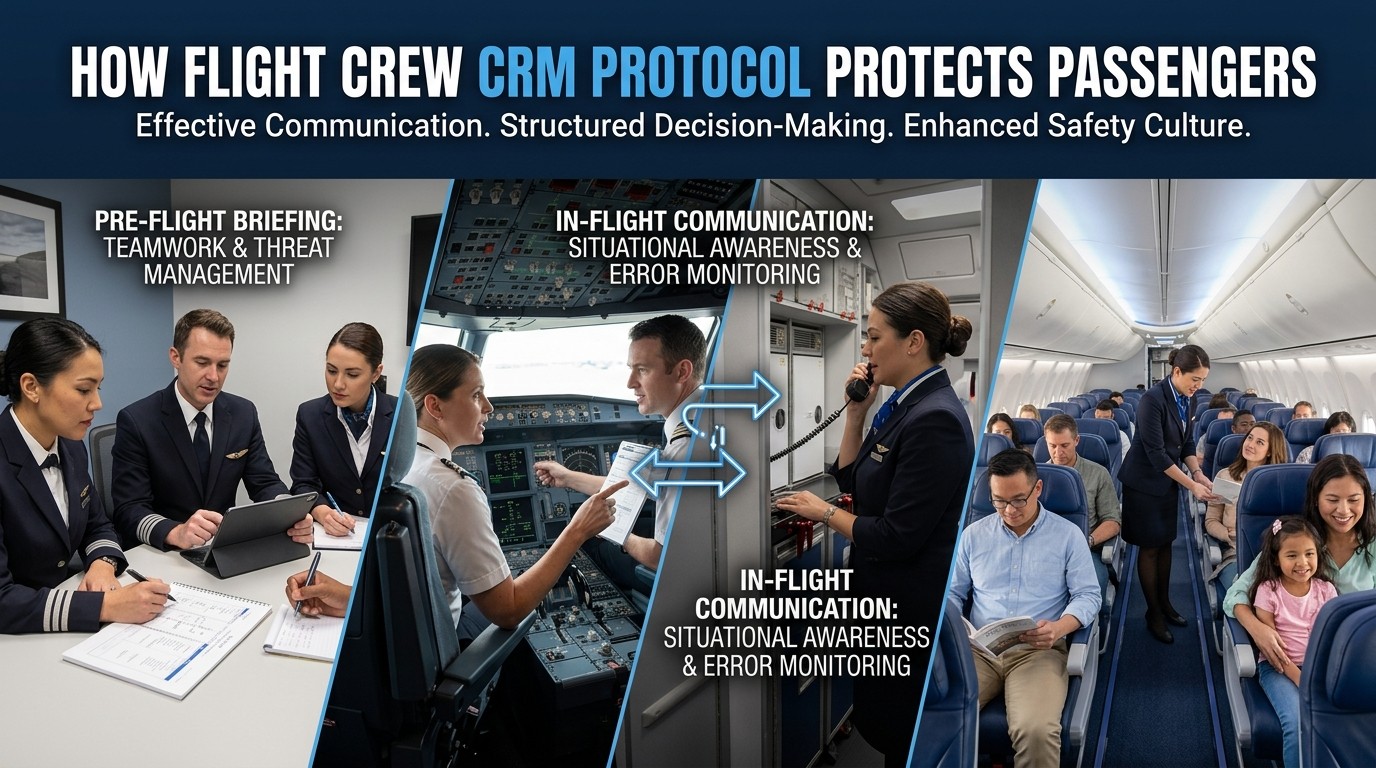
Flight crew CRM protocol is the invisible system running behind every safe flight a structured framework of communication, decision-making, and teamwork that has transformed commercial aviation safety over the past five decades.
When you board a commercial aircraft, you hand over something extraordinary: complete trust in people you have never met, operating machinery you do not understand, in an environment your body was not designed for. Most passengers settle into their seats, listen to the safety announcement, and think relatively little about what is happening on the other side of the cockpit door. What is actually happening there is one of the most sophisticated human coordination systems ever developed in any industry.
Flight crew CRM protocol Crew Resource Management is the structured behavioral framework that governs how pilots, cabin crew, air traffic controllers, maintenance personnel, and ground teams communicate, make decisions, manage risk, and check each other’s work during every phase of flight. It is not a checklist in the conventional sense. It is a cognitive and interpersonal operating system designed to address the single largest cause of aviation accidents in the modern era: not equipment failure, not weather, but human error.
The data behind CRM’s creation is sobering. Human factors contribute to approximately 70 to 80 percent of all aviation accidents. That statistic drove the development of flight crew CRM protocol starting in the late 1970s, and the transformation in commercial aviation safety that followed is one of the most remarkable in the history of transportation. Understanding what CRM actually is, how it works in practice, and why it matters to every person in a passenger seat reframes the aviation safety conversation in ways that go far beyond statistics.
This is not a technical manual. It is an explanation of the human system protecting you every time you fly written for the person in seat 24B who has always wondered what the crew is actually doing when the door closes.
Where CRM Came From: The Accidents That Changed Aviation Forever
The Tenerife Disaster and Its Legacy
On March 27, 1977, two Boeing 747s collided on a runway in the Canary Islands in what remains the deadliest accident in aviation history. Five hundred and eighty-three people died. The cause was not a mechanical failure. The KLM aircraft attempted to take off without clearance in heavy fog. The first officer had concerns. He did not voice them forcefully enough. The captain, one of the most experienced pilots in the airline’s fleet, pressed forward. The combination of authority gradient the unspoken rule that you do not challenge the captain and communication failure killed 583 people.
The Tenerife disaster was not an anomaly. In the years preceding and following it, accident investigators examining flight data recorders and cockpit voice recorders from catastrophic incidents found the same pattern emerging repeatedly. Crews were technically capable. Aircraft were mechanically sound. But communication broke down, junior officers hesitated to speak up, situational awareness was lost, and decisions were made in isolation rather than as a coordinated team. The problem was systemic, not individual.
In 1979, NASA held a workshop on resource management in the cockpit. The research presented documented how often catastrophic errors resulted not from technical failure but from interpersonal and cognitive failures within the crew. The airline industry, led initially by United Airlines in 1981, began developing what would become the first generation of flight crew CRM protocol initially called Cockpit Resource Management, later broadened to Crew Resource Management as the scope expanded beyond the cockpit to include cabin crew, dispatchers, maintenance personnel, and air traffic control.
The Eastern Airlines Flight 401 Precedent
Three years before Tenerife, in December 1972, Eastern Airlines Flight 401 crashed into the Florida Everglades, killing 101 people. The Lockheed L-1011 was in perfect working order. The entire crew three experienced pilots became so focused on troubleshooting a burned-out landing gear indicator light that no one monitored the autopilot. The aircraft descended gradually and unnoticed into the ground. The investigation determined that none of the three crew members were monitoring flight instruments during the final four minutes. A functioning aircraft, an experienced crew, and a fatal outcome from a failure of attention management and task distribution.
Flight crew CRM protocol was built on the accumulated analysis of accidents like these disasters that had nothing to do with skill deficits and everything to do with how humans function in complex, high-pressure environments as part of a team.
The Seven Pillars of Flight Crew CRM Protocol
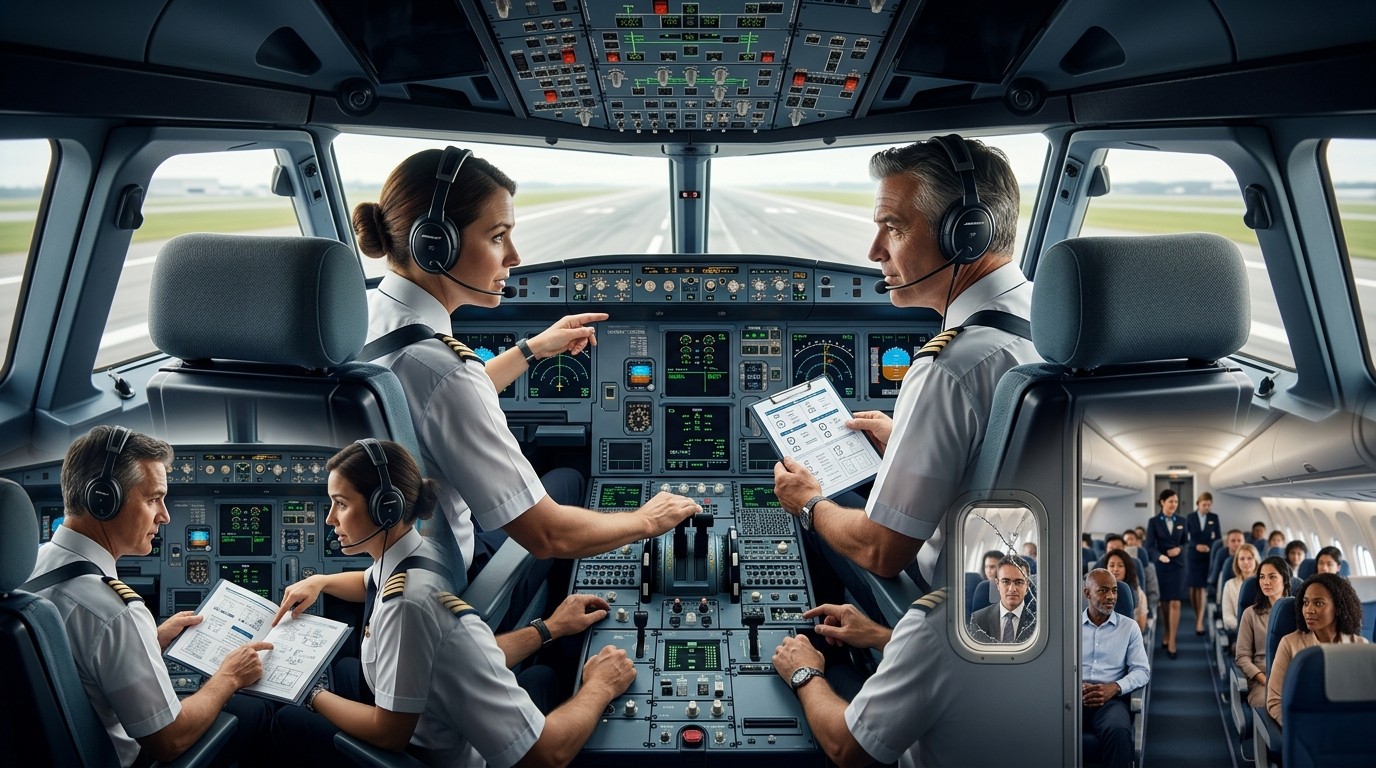
Modern flight crew CRM protocol is structured around a set of core competency areas that translate the lessons of past accidents into trainable, assessable behaviors. These are not abstract principles they are specific skills that crews practice in simulators, assess in line operations, and build into the automatic behaviors that govern every flight.
1. Communication
Communication is the foundation of flight crew CRM protocol and its most visible manifestation in daily operations. The specific techniques required go far beyond speaking clearly.
Closed-loop communication requires that every instruction issued by one crew member be repeated back verbatim by the receiving crew member, who then receives acknowledgment that the readback was correct. “Set flaps to 20” → “Flaps to 20, set” → “Confirmed.” This three-step loop catches mishearings, misunderstandings, and incorrect assumptions before they become errors.
Assertive communication is the practice through which any crew member — regardless of rank or experience — is trained to raise safety concerns with specific, direct language rather than hints or suggestions. The protocol language commonly taught includes a graduated escalation: starting with a statement of concern, escalating to a question, and if necessary escalating to a direct command to stop. No crew member waits passively for a captain to notice a problem if they have identified one.
Briefings and debriefings are formal communication events built into the flight crew CRM protocol structure before and after every flight phase. Pre-departure briefings cover departure procedures, expected threats, abnormal scenarios, and crew role distribution. Approach briefings cover the specific approach procedure, weather minima, go-around criteria, and handling responsibilities. These are not perfunctory recitations — they are structured team alignment sessions that create a shared mental model before the workload increases.
2. Situational Awareness
Situational awareness is the continuous, updated understanding of what is happening around the aircraft, what has happened, and what is likely to happen next. It operates on three levels: perception of current state, comprehension of what that state means, and projection of where it is heading.
Flight crew CRM protocol trains crews to protect situational awareness through specific behaviors: monitoring instruments independently regardless of what the other crew member believes, verbalizing perceptions to cross-check understanding, and using the “sterile cockpit rule” — which prohibits non-essential communication below 10,000 feet — to eliminate distractions during the highest-workload phases of flight.
The loss of situational awareness is what connected the crew of Eastern 401 to dozens of subsequent accidents. Flight crew CRM protocol directly addresses this through the formal role of the Pilot Monitoring — the non-flying pilot whose primary responsibility is not to assist with aircraft control but to maintain the broader picture while the Pilot Flying manages the moment-to-moment task.
3. Decision-Making
In normal commercial aviation, the captain makes final decisions. Flight crew CRM protocol does not change that. What it changes is the process through which decisions are reached. The FORDEC model — a structured decision-making framework used in many airlines — guides crews through Facts, Options, Risks and Benefits, Decision, Execution, and Check. The goal is to prevent two of the most common decision errors in aviation: reactive tunnel vision (locking onto the first available option without considering alternatives) and authority-driven silence (where the most junior person with the best information stays quiet).
The “two-challenge rule” is one of the most important specific protocols embedded in flight crew CRM protocol decision procedures. If a crew member issues a warning or raises a concern that is not acknowledged or acted upon, they are trained and required to raise it a second time, more forcefully. If the situation still is not addressed, they have the authority and responsibility to take direct action. This protocol directly addresses the authority gradient problem that contributed to Tenerife.
4. Workload Management
Human cognitive capacity is not infinite, and the flight environment regularly produces situations where the demands on a crew exceed what any individual can manage safely. Flight crew CRM protocol addresses this through formal workload distribution: pre-assigning who does what under various scenarios, using checklists to reduce cognitive load on individual memory, and recognizing the signs of cognitive saturation in team members before it leads to error.
Task shedding — deliberately dropping lower-priority tasks when workload exceeds capacity — is a trained behavior within flight crew CRM protocol. A crew managing a systems failure at high altitude does not simultaneously run routine fuel calculations or engage in non-essential radio communications. The protocol defines what gets dropped and what gets maintained.
5. Leadership and Followership
Flight crew CRM protocol recognizes that effective crews require both effective leaders and effective followers — and that the two roles are distinct skills. The captain must create an environment where junior crew members feel genuinely safe to raise concerns, provide information, and challenge decisions. The first officer and other crew members must develop the assertiveness to use that environment rather than deferring to rank under pressure.
This balance — called “authority gradient management” — is one of the areas where flight crew CRM protocol training has been most transformative. The old model of cockpit culture, where the captain’s word was absolute, produced the conditions for Tenerife. The CRM model produces a cockpit where the captain leads but is also the most actively questioned member of the crew.
6. Threat and Error Management (TEM)
Modern flight crew CRM protocol has incorporated Threat and Error Management as a core framework that extends CRM principles into a practical operational structure. TEM works in three stages: identifying threats before they become errors, managing errors when they occur before they become undesired aircraft states, and recovering from undesired aircraft states before they become accidents.
Threats are categorized: environmental (weather, terrain, airspace complexity), airline-related (scheduling pressures, equipment issues), crew-related (fatigue, complacency, knowledge gaps), and external (air traffic control instructions, ground crew actions). Training crews to actively identify and name threats — rather than assuming everything will proceed nominally — is a central mechanism of flight crew CRM protocol.
7. Crew Coordination and Cross-Checking
Formal cross-checking — where both crew members independently verify critical parameters rather than one assuming the other has checked — is built into every phase of flight through standard operating procedures reinforced by flight crew CRM protocol. Altitude settings, configuration changes, fuel states, and navigation waypoints are all independently verified on the premise that human attention is fallible and redundancy is the defense.
How Cabin Crew Became Part of the CRM System
The initial framing of what became flight crew CRM protocol focused exclusively on the cockpit. A series of accidents in the late 1980s and 1990s demonstrated that this was an incomplete model.
The Air Ontario Flight 1363 accident in 1989 is the instructive case. The aircraft took off with ice contamination on the wings. Passengers observed the ice from the cabin windows and made comments. The cabin crew heard these comments but did not communicate the concern to the flight deck, partly because the operational culture did not define that kind of communication as within their role. The aircraft crashed on takeoff.
That accident, and the investigation that followed, directly shaped the expansion of flight crew CRM protocol to include cabin crew as integrated participants rather than separate operators. Modern CRM training now covers the full team: the flight deck, the cabin crew, maintenance personnel, dispatchers, and in some frameworks, air traffic controllers. The principle is that safety information can enter the system from any point, and every member of the team has the training and authority to route that information to where it can prevent an error from becoming an accident.
The practical manifestation of this integration includes pre-flight joint briefings between cockpit and cabin crews, standardized procedures for cabin crew to communicate flight deck-relevant observations (unusual sounds, visual anomalies, passenger behavior suggesting security concerns), and a specific protocol for cabin crew to escalate concerns if they believe the flight is not proceeding safely.
Flight Safety Briefings: The Passenger-Facing Element of CRM
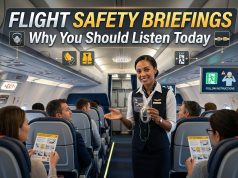
The safety demonstration you watch — or, more accurately, that plays on the screen while you read your phone — is the most visible passenger-facing element of a much larger safety architecture. Flight safety briefings are required by aviation regulatory authorities in every commercial jurisdiction and cover exit location, seatbelt use, oxygen mask deployment, and the brace position. They exist because the data from accident investigations has established that passengers who have attended to safety briefings survive emergencies at higher rates than those who have not.
But flight safety briefings are also part of the broader CRM framework in a way that passengers rarely consider. Cabin crew conducting the briefing are simultaneously establishing their role as safety authorities in the cabin, observing the passenger environment for any unusual behavior or medical concerns, and executing a checklist item that is part of the pre-departure safety verification chain.
Modern aviation regulators have pushed for more engaging delivery of flight safety briefings in recognition of the cognitive reality that standardized safety information delivered in a low-engagement format is not reliably retained. Some airlines have invested significantly in video production quality, humor, and cultural localization precisely because the underlying data from accident investigations reinforces the value of passengers who know what to do when crew instructions are given during an emergency.
Aviation Safety Protocols: The Regulatory Architecture Behind CRM
Flight crew CRM protocol does not exist in isolation. It operates within a comprehensive architecture of aviation safety protocols mandated by regulatory authorities including the Federal Aviation Administration (FAA), the European Union Aviation Safety Agency (EASA), and the International Civil Aviation Organization (ICAO).
The FAA’s Advisory Circular AC 120-51 provides the foundational guidance document for CRM training in US-certificated air carrier operations. It defines the required content of CRM training programs, the recurrency requirements, and the integration of CRM with line-oriented flight training (LOFT) simulator scenarios designed specifically to test CRM skills rather than technical flying ability.
The regulatory requirement for CRM training was extended to Part 135 operators (regional and charter carriers) through an FAA final rule that requires all certificate holders conducting operations under Part 135 to include CRM training for crewmembers, including pilots and flight attendants. This regulatory expansion reflected the evidence that CRM breakdowns were not limited to large commercial carriers.
| CRM Training Component | Regulatory Basis | Frequency |
|---|---|---|
| Initial CRM Training | FAA AC 120-51 / EASA regulations | Before line operations |
| Recurrent CRM Training | Carrier-specific program | Annual minimum |
| LOFT (Simulator scenarios) | Integrated with type rating | Per training cycle |
| Threat and Error Management | Modern CRM 7.0 framework | Embedded in all training |
| Cabin-Flight Deck Integration | ICAO Annex 6 | Pre-flight briefing (every flight) |
How CRM Actually Works in Real-Time: A Flight From Departure to Arrival
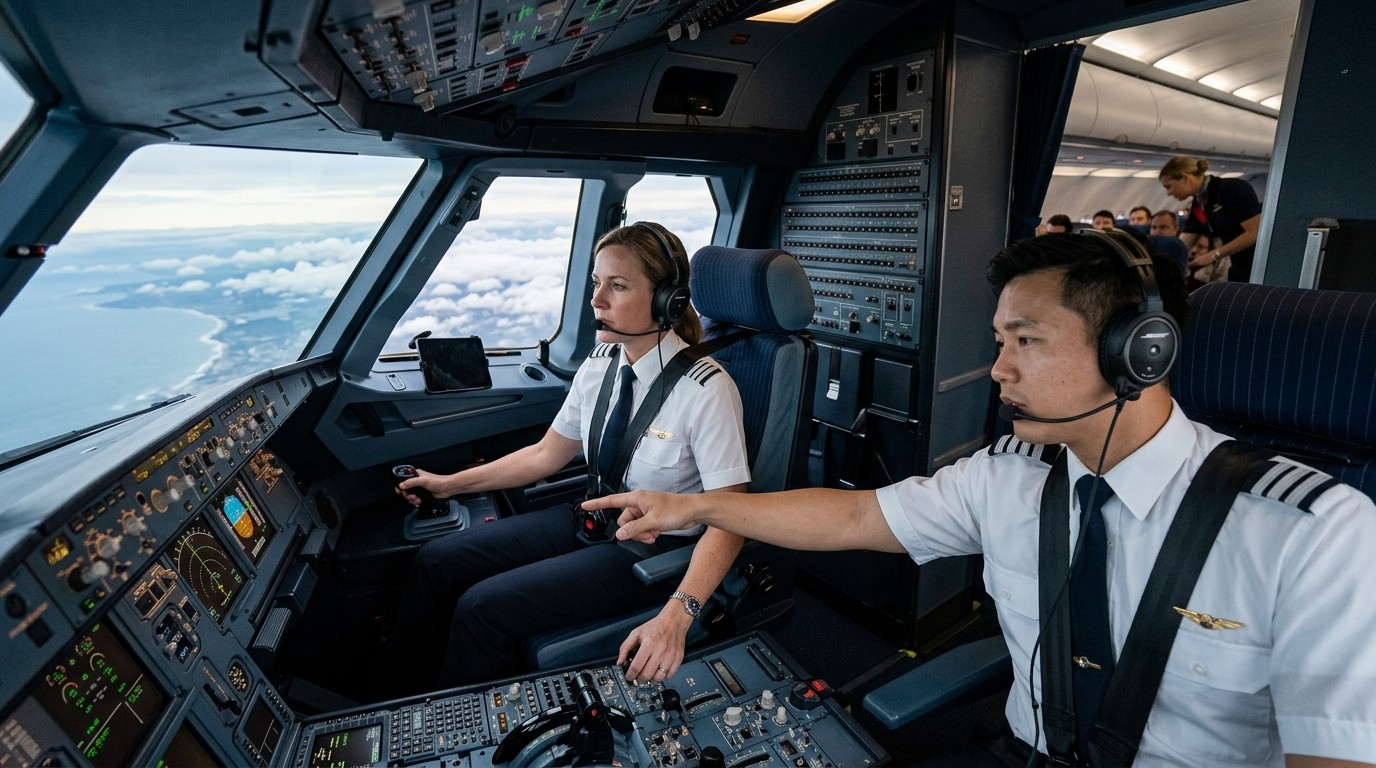
Understanding flight crew CRM protocol in the abstract is less illuminating than seeing how it operates in practice across a typical commercial flight.
Pre-Departure: Building the Shared Mental Model
Before passengers board, the captain and first officer are conducting a formal pre-flight briefing. This is not casual conversation it is a structured alignment session guided by flight crew CRM protocol. They review the planned route, anticipated weather, any relevant notams (notices to air missions) about equipment or airspace, the aircraft’s technical state, and any crew-specific factors including rest patterns and currency on type. They discuss what they would do if the engine fails on takeoff. They agree on decision criteria for a go-around on approach. They establish who will fly the departure and who will monitor.
This shared mental model is the foundation that flight crew CRM protocol builds on. When an abnormal event occurs during the flight, the crew is not starting from a cold state they are updating an already-established shared picture.
Takeoff and Climb: Sterile Cockpit and Role Distribution
Below 10,000 feet, the sterile cockpit rule is in effect. Communication is restricted to operationally necessary exchanges. The Pilot Flying manages the aircraft controls and callouts. The Pilot Monitoring monitors the instruments independently, calls out deviations, manages radio communications, and maintains situational awareness at a broader level. Checklists are completed in the call-challenge-response format, where one pilot calls the item, the other action and confirms, and the first pilot verifies.
If an abnormality occurs during takeoff an engine indication, a warning light, an EICAS message the flight crew CRM protocol defines exactly who does what. The Pilot Flying continues to fly the aircraft. The Pilot Monitoring identifies and calls out the issue. The abnormal procedure is then executed from memory for the immediate-action items, then from the checklist for the subsequent steps. Communication follows the closed-loop protocol. Neither crew member acts unilaterally.
Cruise: Monitoring, Fatigue Management, and Automation Oversight
In cruise, the CRM challenges shift. The primary threat is complacency and automation dependence. Modern aircraft fly for hours on autopilot with minimal physical input required from the crew. The cognitive danger of automation is that it creates an environment of passive monitoring an attentional state that research in human factors has shown produces significantly degraded response capacity when sudden action is required.
Flight crew CRM protocol addresses this in cruise through periodic manual flight segments, active monitoring callouts, and cross-checks at regular intervals. Fatigue is explicitly addressed: crew members are trained to recognize the signs of fatigue in themselves and their colleagues, and the CRM framework creates a communication environment where acknowledging fatigue is a safety behavior, not a professional weakness.
On long-haul flights with augmented crews three or four pilots who rotate rest periods flight crew CRM protocol includes formal handover briefings that transfer the shared mental model from the resting crew to the incoming crew before rest periods begin and end.
Approach and Landing: The Highest-Risk Phase
Approximately 65 percent of fatal commercial aviation accidents occur during the approach and landing phase, which represents only about 4 percent of total flight time. The concentration of risk in this phase is directly addressed by flight crew CRM protocol through the approach briefing, stabilized approach criteria, and go-around decision-making.
Every commercial approach begins with a formal approach briefing that reviews the specific instrument procedure, the weather minima, the missed approach procedure, and the go-around criteria. Critically, flight crew CRM protocol establishes the go-around call as belonging to any crew member not only the captain. A first officer who observes that the aircraft is not meeting the stabilized approach criteria at the defined gate has the training and protocol authority to call for a go-around, and the captain has the trained obligation to respond to that call. The two-challenge rule applies here as explicitly as anywhere in flight.
The Generational Evolution of Flight Crew CRM Protocol
Flight crew CRM protocol has not remained static since 1979. It has developed through a series of recognizable evolutionary phases, each responding to new accident data, human factors research, and operational experience.
The first generation focused on individual psychology identifying personality traits that contributed to command errors and attempting to modify them. This proved to have limited practical effect and was largely replaced by the second generation, which shifted focus to cockpit group dynamics and interpersonal communication.
The third through fifth generations progressively broadened the scope: extending CRM beyond the cockpit, incorporating cultural factors (research showed that authority gradient sensitivity varied significantly across national and organizational cultures), and integrating error management as a formal framework. Research established that errors were not simply failures of individual competence but predictable outcomes of complex human systems under pressure.
The sixth and seventh generations often called CRM 6.0 and CRM 7.0 represent the current state of the field. They integrate flight crew CRM protocol with Threat and Error Management as an overarching framework, incorporate automation and human-machine interface considerations into CRM training, and explicitly address the psychological safety dimension: creating crew environments where every member genuinely feels safe to speak up rather than merely having organizational permission to do so.
Psychological safety the research concept developed by Harvard Business School professor Amy Edmondson in a completely different organizational context maps precisely onto what CRM has been building toward for four decades. The cockpit that functions according to best-practice flight crew CRM protocol is an environment where the most junior crew member feels as confident raising a safety concern as the most senior one. That confidence is not organic it is trained, reinforced through simulator scenarios, assessed in line operations, and embedded in the culture of airlines that take CRM seriously.
Flight Risk Management Guide Principles Within CRM
One of the more practically important elements of modern flight crew CRM protocol is its integration with systematic risk assessment before and during flight. Threat and Error Management is, at its core, a specific application of flight risk management guide principles to the aviation operating environment.
Pre-flight risk assessment is now a formal part of flight crew CRM protocol in most major airlines. Crews are trained to explicitly identify the threats present in their specific operation not just the general category of threats that apply to all flights, but the specific combination of weather, aircraft condition, crew fatigue state, airspace complexity, and destination characteristics that apply to this flight today. This threat inventory then shapes briefing emphasis, contingency planning, and crew attention allocation during the flight.
The SHELL model frequently used in flight safety training provides a framework for identifying risk factors across Software (procedures), Hardware (equipment), Environment (physical and operational context), and Liveware (human factors). Understanding how these elements interact during a specific operation is a trained CRM skill that allows crews to identify risk concentrations before they become consequential.
CRM Beyond the Cockpit: Maintenance, Dispatch, and Ground Operations
One of the most significant expansions of flight crew CRM protocol in the past two decades has been its extension into maintenance operations, dispatch, and ground handling — the parts of the aviation system that affect flight safety but happen outside the aircraft.
Maintenance CRM sometimes called M-CRM applies the same fundamental principles of communication, situational awareness, and error management to the environment where aircraft are repaired and serviced. The Aloha Airlines accident of 1988, in which explosive decompression occurred at altitude due to metal fatigue that should have been caught during maintenance inspections, is among the most-cited cases for CRM breakdown in a maintenance context. The inspection process that failed did so partly because of CRM issues: inadequate communication between inspection team members about the status of checks, and a culture that did not encourage the kind of assertive reporting that CRM training builds.
The integration of flight safety and travel risk management principles across the full aviation chain from aircraft manufacture and maintenance through crew training, dispatch, and operations represents the fullest expression of what flight crew CRM protocol was designed to achieve: not just better-coordinated cockpits, but a system-wide safety culture that treats human coordination as seriously as mechanical engineering.
What Passengers Never See: CRM in Emergency Scenarios
When aviation emergencies are depicted in films, they almost invariably show one person usually the most experienced pilot, usually the captain thinking fast and saving the day alone. Real emergency management in commercial aviation looks almost nothing like this, and the difference is entirely the product of flight crew CRM protocol.
In a real declared emergency, the cockpit becomes a highly structured environment. The Pilot Flying focuses on aircraft control. The Pilot Monitoring manages communications, runs checklists, and monitors the broader situation. The cabin crew are notified through a standardized interphone procedure and transition into their own emergency protocols. Dispatch and the airline’s operations center receive notification. Air traffic control clears the relevant airspace and activates emergency services. All of this happens in parallel, coordinated by the same flight crew CRM protocol framework that governs the routine turn.
The crew of US Airways Flight 1549 the “Miracle on the Hudson” in January 2009 executed one of the most celebrated emergency landings in aviation history. Captain Sullenberger and First Officer Skiles had approximately 208 seconds from bird strike to water landing. In that time, they executed the dual engine failure checklist, evaluated and rejected available runway options, chose the Hudson River, flew a forced landing into the water, and maintained crew coordination throughout. Interviews after the event documented how completely their actions in those 208 seconds reflected CRM principles role distribution, communication, shared decision-making, and a maintained shared mental model of their situation. Sullenberger himself has attributed the successful outcome specifically to crew training including CRM.
How CRM Training Is Delivered: From Classroom to Simulator
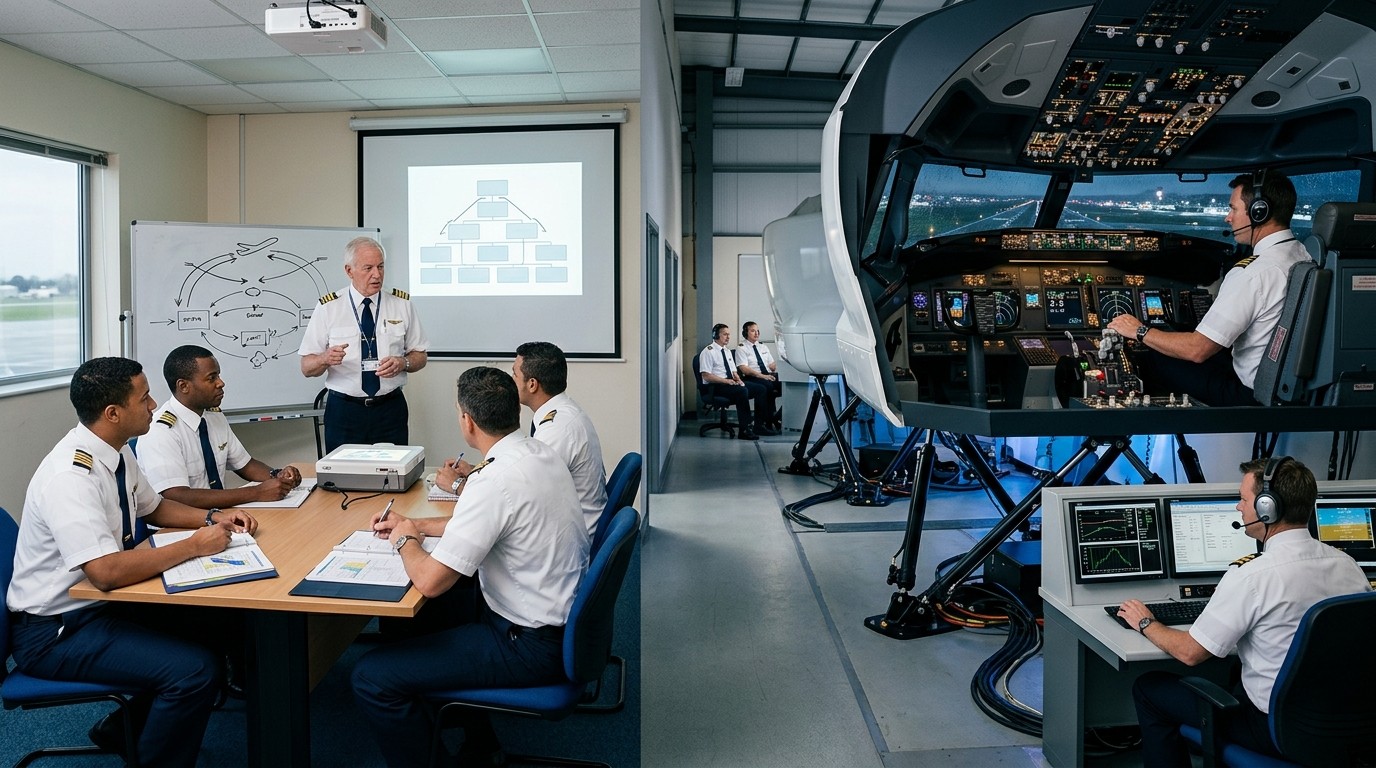
Flight crew CRM protocol is not delivered in a single course and then considered complete. It is embedded throughout the career of every commercial aviation professional through an overlapping set of training mechanisms.
Initial Training
CRM is introduced at the earliest stage of professional aviation training — often at flight school, before a pilot has accumulated the experience to contextualize it fully. The principles are taught conceptually and then practiced in paired flying exercises designed to simulate real crew dynamics. For flight attendants, initial CRM training covers the cabin crew’s specific role in the broader team, the communication protocols for interacting with the flight deck, and the scenarios in which cabin observations might have flight-safety implications.
Line-Oriented Flight Training (LOFT)
LOFT is the simulator training methodology specifically designed to develop and assess CRM skills. Rather than isolating specific technical procedures, LOFT scenarios present realistic operational situations often replicating actual accident scenarios — and require crews to manage them using both their technical skills and their CRM behaviors. Evaluators assess communication, workload distribution, decision-making, and threat and error management alongside the technical outcomes.
Recurrent Training and Assessment
Recurrent CRM training is required at regular intervals — typically annually — and is assessed rather than simply attended. Line checks conducted on actual flights evaluate CRM behaviors in the live operating environment, not only in the simulator. Some airlines have introduced crew feedback instruments that allow flight crew members to provide structured assessment of each other’s CRM behaviors after shared flights.
Cultural Adaptation
One of the more complex dimensions of flight crew CRM protocol delivery is cultural adaptation. Research has documented significant variation in authority gradient sensitivity, communication directness, and error reporting norms across national cultures. Airlines operating multicultural crews which includes virtually every major international carrier adapt CRM training to explicitly address these variations, building the interpersonal skills to navigate cultural differences in communication style without compromising the safety-critical elements of the protocol.
Conclusion
Flight crew CRM protocol is the most thoroughly researched, most extensively implemented, and most consequential human performance system in commercial transportation. It was built from failure from the wreckage of accidents that killed hundreds of people in situations where technical competence alone could not have saved them. It has been refined through five decades of accident investigation, human factors research, simulator training, and operational experience. The result is a commercial aviation industry that is, by measurable safety outcomes, the safest form of transportation ever created. The next time you board a flight, what is protecting you most is not the aircraft’s engineering tolerances or the backup systems built into modern avionics though those matter enormously. It is the coordinated human system trained to catch, manage, and correct the errors that no engineering redundancy fully eliminates. That system is flight crew CRM protocol, and it is running every second of every flight you take.
Frequently Asked Questions (FAQ)
1. What does CRM stand for in aviation, and what is flight crew CRM protocol?
CRM stands for Crew Resource Management. Flight crew CRM protocol is the structured set of communication, decision-making, situational awareness, and team coordination practices that commercial flight crews are trained to use to reduce human error and respond effectively to emergencies. It governs how crew members interact with each other, with cabin crew, with air traffic control, and with other operational stakeholders throughout every flight.
2. How did CRM start in aviation?
CRM grew from accident investigations in the 1970s that revealed a pattern: many catastrophic crashes resulted not from technical failure but from breakdowns in communication, decision-making, and team coordination among technically competent crews. The 1977 Tenerife disaster, which killed 583 people due in part to a first officer’s failure to challenge a captain’s decision, was the pivotal catalyst. NASA hosted a workshop on resource management in the cockpit in 1979, and United Airlines implemented the first formal CRM training program in 1981.
3. Does CRM training actually make flights safer?
Yes — the evidence is extensive. Commercial aviation fatality rates have declined dramatically since the introduction of CRM training, and studies of accident investigations consistently identify CRM breakdowns as contributory factors in incidents while documenting CRM-consistent behavior in cases where crews successfully managed serious emergencies. The industry consensus, supported by regulatory mandates from the FAA and EASA, treats CRM as a foundational safety requirement.
4. What is the sterile cockpit rule and how does it relate to CRM?
The sterile cockpit rule prohibits non-essential communication in the cockpit below 10,000 feet — the highest-workload, highest-risk phases of flight (takeoff, climb, approach, and landing). It is a specific operational protocol that supports the CRM principle of workload management by eliminating distractions when crew cognitive resources need to be fully directed at the flight task. It is mandated by the FAA under 14 CFR 121.542.
5. Are flight attendants part of CRM training?
Yes. Modern flight crew CRM protocol explicitly includes cabin crew as integrated participants in the safety system — not separate operators. Cabin crew receive CRM training that covers communication with the flight deck, threat identification in the cabin, and the protocols for escalating safety-relevant observations to the cockpit. The expansion to include cabin crew followed accident investigations that showed cabin observations could have prevented crashes where the information never reached the flight deck.
6. What is Threat and Error Management (TEM) and how does it relate to CRM?
TEM is a framework integrated into modern flight crew CRM protocol that structures how crews identify risks before they become errors, manage errors before they become undesired aircraft states, and recover from undesired states before they become accidents. It is the operational architecture of modern CRM — translating CRM principles into a practical pre-flight risk assessment and in-flight error management process.
7. What is the two-challenge rule in CRM?
The two-challenge rule is a specific protocol within flight crew CRM protocol that requires any crew member whose safety concern is not acknowledged or acted upon to raise that concern a second time, more directly and forcefully. If still not acted upon, the crew member has the authority and responsibility to take direct action to prevent the unsafe situation from continuing. It directly addresses the authority gradient problem where junior crew members historically deferred to senior ones even when they had safety-critical information.
8. How does automation affect CRM in modern aircraft?
Modern highly automated aircraft create specific CRM challenges that flight crew CRM protocol has evolved to address. Automation can reduce active engagement with the flight environment, creating complacency and degraded situational awareness. CRM training for modern operations includes automation management: understanding the modes the aircraft is operating in, maintaining awareness of what the automation is doing and about to do, and actively deciding when to monitor, intervene, and hand-fly rather than passively supervising automated systems.
9. Is CRM required by law for commercial airlines?
Yes. In the United States, CRM training is required by the FAA for all Part 121 air carrier operations (commercial airlines) and has been extended to Part 135 operators (regional and charter carriers) through regulatory rule. EASA requires CRM training for commercial air transport operations in European-regulated carriers. ICAO establishes international standards for CRM through Annex 1 to the Chicago Convention, which member states implement through their national regulations.
10. What happens to CRM when a crew faces a genuine emergency?
In a genuine emergency, flight crew CRM protocol becomes even more critical not less. The cockpit becomes a highly structured environment where the Pilot Flying focuses on aircraft control, the Pilot Monitoring manages communications and checklists, the cabin crew execute their own emergency protocols, and the entire crew maintains a shared mental model of the situation through deliberate communication. The US Airways 1549 “Miracle on the Hudson” is the most documented example of expert CRM execution under extreme time pressure 208 seconds from incident to water landing, with crew coordination maintained throughout.